My struggle to make sense of this new era of Trump has sent me back to my journals to look for longer threads and themes. I’m having an old feeling. It’s one I associate with the time of the assassinations in the 1960s, the lying during the Nixon and Johnson years, and the warmongering of the Bush years. In such times of disruption in my mental model of a world that progresses—carefully inculcated by my post-war teachers—I am thrown into questions.
Finding myself back in the questions again, I came across a journal entry from December 1994, recounting a talk with my friend Bob Horn about postmodernism. Our talk began with a review of Walter Truett Anderson’s schematic of the postmodern challenge:
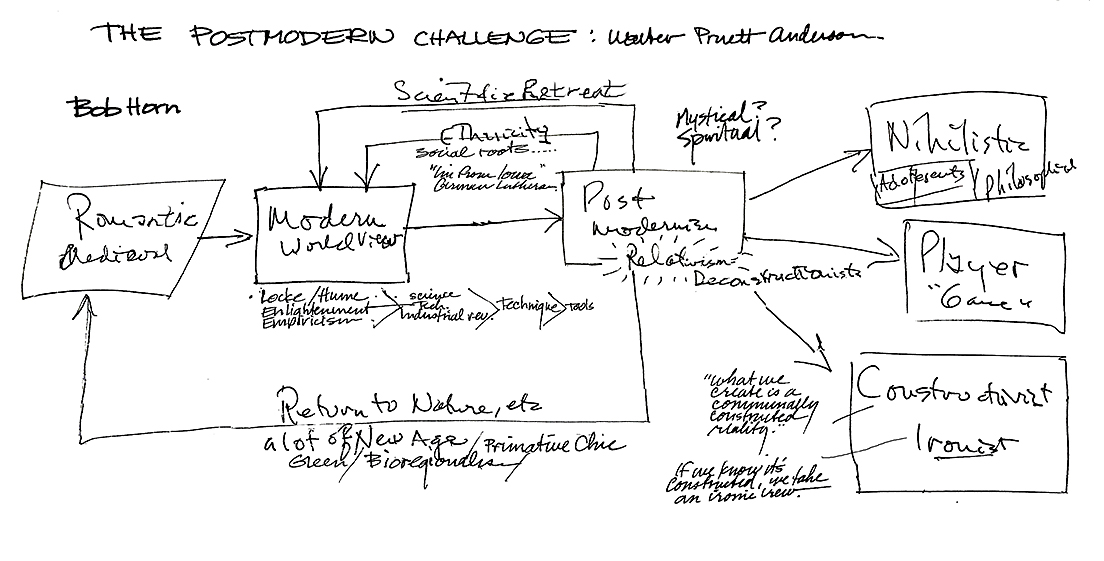
As Bob drew the boxes, I had wondered at the casualness with which he could lay down a box and label it “postmodernism”, as if all the perceptions and theorizing and turmoil of the times could be neatly packaged in a historian’s bow. “I won’t say anything,” I thought. “I’ll listen past it to the meaning.” Meanwhile, in my own mind I began to frame a story of fragmentation and return, of choices and confusion.
We talked of “context.” Stewart & Cohen’s book Collapse of Chaos has given me some language for looking at modern thought. I find I can make sense of some of this if I consider scientific inquiry, and the search for theories of everything, as the leit motif of the 1900s when science and scientism became the norm for respectable thinking. Scientists embraced laboratory learning as a key to the mysteries, leading steadily toward less contextualized formulations being lauded as the “laws of nature.”
Bob and I then looked at the development of organizational theory through the postmodern lens, speculating on the reasons for strategic planning’s popularity in the 1970s.
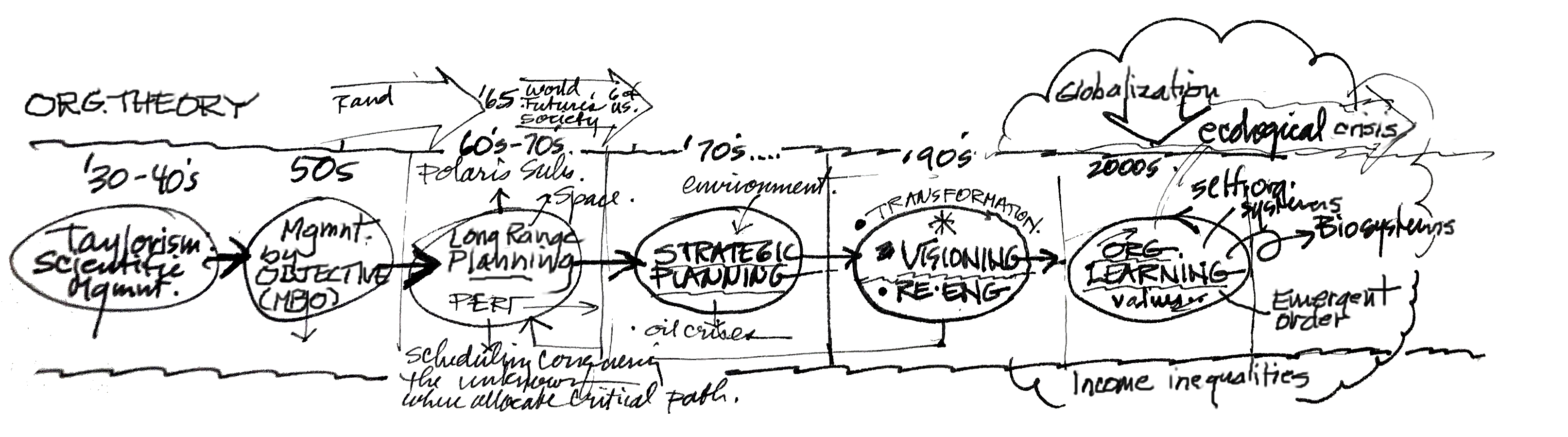
Why did environment & context become so important at that juncture? I surmised that the uncertainty of the late ‘60s, the oil crisis, and the allure of reductionist thinking had reached a dead end. Also, the flood of data from new tools and instruments was outstripping the old paradigms.
World War II, terrible and chaotic as it was, was accompanied by a sense of moral certitude that aligned people in a shared focus on action and problem solving. Back then there was little confusion about our core story: America was saving the world for peace. (As that story faltered, the need for strategy grew.)
Now our stories rot in the barnyard of media, stomped, eaten and regurgitated like social cuds. We grimace at the latest crime stories at the same time our hungry eyes beeline to the familiar and the bizarre.
“I want to work to keep the bigger stories from being lost to the smaller ones!” I said. “It’s a small story to figure out how to sell the next gadget more cheaply than a competitor. (And how to win personally, I now realize.) It’s a big story to imagine the unleashed power of diversity and organizational learning.”
Now, 22 years later, I’m aware that as upset I was back then about the disruption of our core story, I couldn’t have imagined our current situation. The postmodern challenge I sensed then is even bigger. But interestingly, the efforts to forge a new narrative do fall into Bob’s three postmodern buckets. Judging from many new movies, the apocalypse is near and dark, and nihilistic narratives grow steadily on the Internet. Based on our new president and press secretary’s speeches, gaming the system is acceptable and even hailed as “smart” as long as you win. I’m in the third bucket: working to help a constructivist story emerge.
I want to believe that those of us who care about public service, community, children, families, income equity, respect for indigenous cultures, and sensitivity to the impact of actions on others will learn how to share and amplify a new narrative. I hope it embraces these values and provides enough constancy to inspire and sustain new institutions, like the collaborative network we are calling the GLEN (Global Learning & Exchange Network). This is the work that calls me to action. This is our postmodern challenge.